
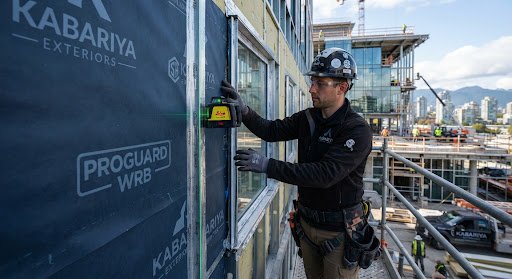
When a facade fails, the first question is never which material failed — it is who was responsible for the part that failed. Manufacturers write their warranties around that question in very specific language, and the most common way a twenty-year finish warranty evaporates is a divided scope: one company supplies the material, a different company installs it, and neither one owns the detail in between.
Keeping supply and installation with a single accountable team is not a commercial preference. It is the condition that keeps the warranty, the test report and the as-built detail pointing at the same assembly.
Where Split Responsibility Breaks Down
Warranties typically cover defects in the material under stated conditions of use — correct substrate, correct fastener, correct spacing, correct drainage, and installation in accordance with the published instructions. Those conditions are all installation conditions, which means a supply-only warranty is effectively a warranty on the panel plus a promise about somebody else\u2019s workmanship.
The failure modes are predictable: panels installed over an unvented substrate, fasteners substituted because the specified ones were not on site, joints sealed where the system called for an open drainage path. Each one is invisible in a photograph on handover day and each one shows up as a leak or a stain three years later.
One Point of Accountability
When the same team details, supplies and installs, the shop drawings, the submittals and the crew on the scaffold are all working from one set of decisions. Defects get corrected in the field that afternoon instead of becoming a dispute about whether the panel or the substrate was at fault.
It also means the person who signed off on the envelope detail is the same person who watched it being built — and that continuity is what an owner is really buying when they ask for a warranty.
- check_circle One contract, one scope, one party responsible for the drained-cavity detail.
- check_circle As-built shop drawings issued at completion, matching what was actually installed.
- check_circle Manufacturer installation training documented for the crew that did the work.
- check_circle A single warranty register — material, finish and workmanship — issued together.
What to Ask Before You Award
Ask who installs, and then ask for the manufacturer\u2019s written confirmation that installing the assembly with that team keeps the material warranty intact. Ask for a sample of the as-built detailing package, and ask which crew will actually be on your project — training records follow the crew, not the company name.
Finally, ask what happens if a defect appears in year nine. The answer should name a single phone number, not a chain of three parties each pointing at the other.
Key Takeaways
- arrow_forward Material warranties are conditional on installation — read the conditions before the price.
- arrow_forward Split supply/install scopes move the risk onto the owner, not off it.
- arrow_forward One party detailing, supplying and installing keeps drawings, submittals and crew aligned.
- arrow_forward Request written confirmation that the installing team preserves the manufacturer warranty.
- arrow_forward Warranty paperwork should be issued as one register, not three separate documents.


